Search / 6 min read
Service-area pages that answer real customer questions
Decide when a service-area page helps customers, what local facts belong on it and when one county coverage page is enough. Includes a planning worksheet.
Begin with a customer decision
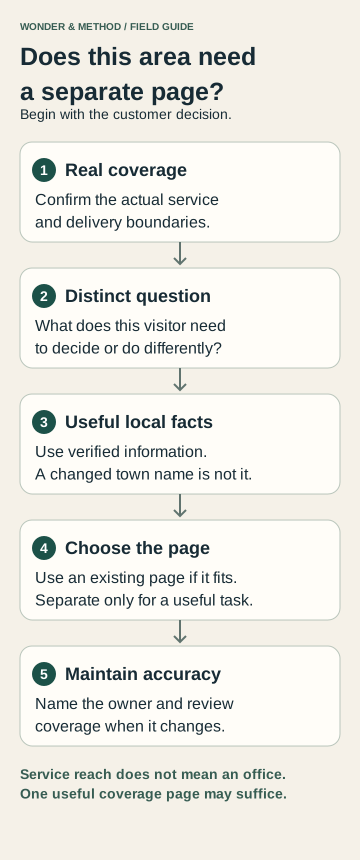
A service-area page should help someone decide whether and how a business can serve them. A place name alone does not answer that question. Before writing, identify the useful decision: availability at an address, remote versus on-site delivery, the relevant service, or information needed for a quote.
Separate a coverage list from a landing-page plan. A list can reassure a visitor that their community is within the intended area. It does not automatically justify a new page for each place. For a small service business, one clear service page and an accurate coverage explanation may answer more questions than many nearly identical pages.
Confirm what the business actually does
Ask the owner to confirm the service, delivery method and boundaries before drafting local claims. Record whether work happens online, at the customer’s property or at a genuine business location. Identify any address-level assessment, travel charge or scheduling condition that customers need to understand; leave unknown conditions unresolved until the business supplies them.
- Which services are available in this area, and which are not?
- What must a customer provide to establish fit or request a quote?
- Is there a genuine local difference that changes the decision?
- Who will keep the information current when coverage changes?
Do not convert service reach into an office claim. A business can explain remote delivery to customers in a place without saying it has premises there. Business Profile eligibility is a separate question covered in the local SEO and profile guide.
Choose the smallest useful page structure
Use an existing service page when the customer needs the same explanation wherever they live. Add a coverage section when the main distinction is whether an area is served. Consider a separate page when a visitor has a distinct question and the business can supply substantive facts that answer it. There is no useful minimum city count or required number of location pages.
For example, an established service may have different booking requirements in a particular area. If those requirements are real, meaningful and maintained, they may warrant a separate explanation. A paragraph about a landmark, a stock photograph and the same contact button do not establish a different customer task.
Google’s search spam policies describe doorway abuse and keyword stuffing, including pages or city blocks created to manipulate search visibility. The practical editorial decision here is to consolidate overlapping questions and keep local statements useful to customers.
Work through an illustrative example
Imagine a fictional exterior-cleaning business that serves several nearby communities. Its actual quote process requires photographs, the surface type and access details. If those requirements are the same everywhere, one cleaning-service page can explain them and link to a coverage section. Repeating that page with a different town heading adds little to the quote decision.
Now suppose the owner supplies a verified difference: one service is offered only within a smaller route area on stated days. The useful addition is a clear explanation of that service’s actual availability and how a customer checks their address. It may fit as a section on the service page. A separate page is an option only if there is enough distinct information to help the visitor.
This is a fictional planning example, not a studio client, service recommendation or statement about local operating conditions. Any real business must supply its own coverage and booking facts.
Write the page around the next action
Start with the service and the audience. Explain delivery, relevant boundaries, what the customer needs to provide and what happens next. Use actual evidence where available: an approved explanation of the process or a genuine, permissioned project. If no local project evidence exists, describe the process plainly instead of inventing a case study.
Connect the page to the main service, pricing or quote explanation and a relevant contact step. A reader should be able to move between the detailed service and its coverage without starting again from the homepage. Use descriptive links that explain the destination; repeating a service-and-city phrase in every link does not make the route easier to understand.
For a new site, agree these page purposes in the website brief. For an existing site with overlapping local pages, inventory their useful content and URLs before consolidating anything; the migration checklist explains why redirect decisions need a plan.
Keep the coverage honest and current
Based in Buffalo, serving businesses across New York online. Our Erie County coverage page gives more detail about the studio’s home county. Its community names do not claim offices, local client relationships or a different package in each place. That is a deliberate fit between the page and the studio’s delivery model.
Review your own coverage when services, staffing or booking conditions change. Record the owner’s confirmation and the pages affected. Use available search and inquiry information to find unanswered customer questions, rather than treating every keyword variation as a publishing instruction.
The next step may be one better service section, a clearer county page or a genuinely distinct new page. SEO research and implemented website improvements can help decide which change is useful. Measure what happens after the work, and keep outcomes separate from the fact that a page was published.